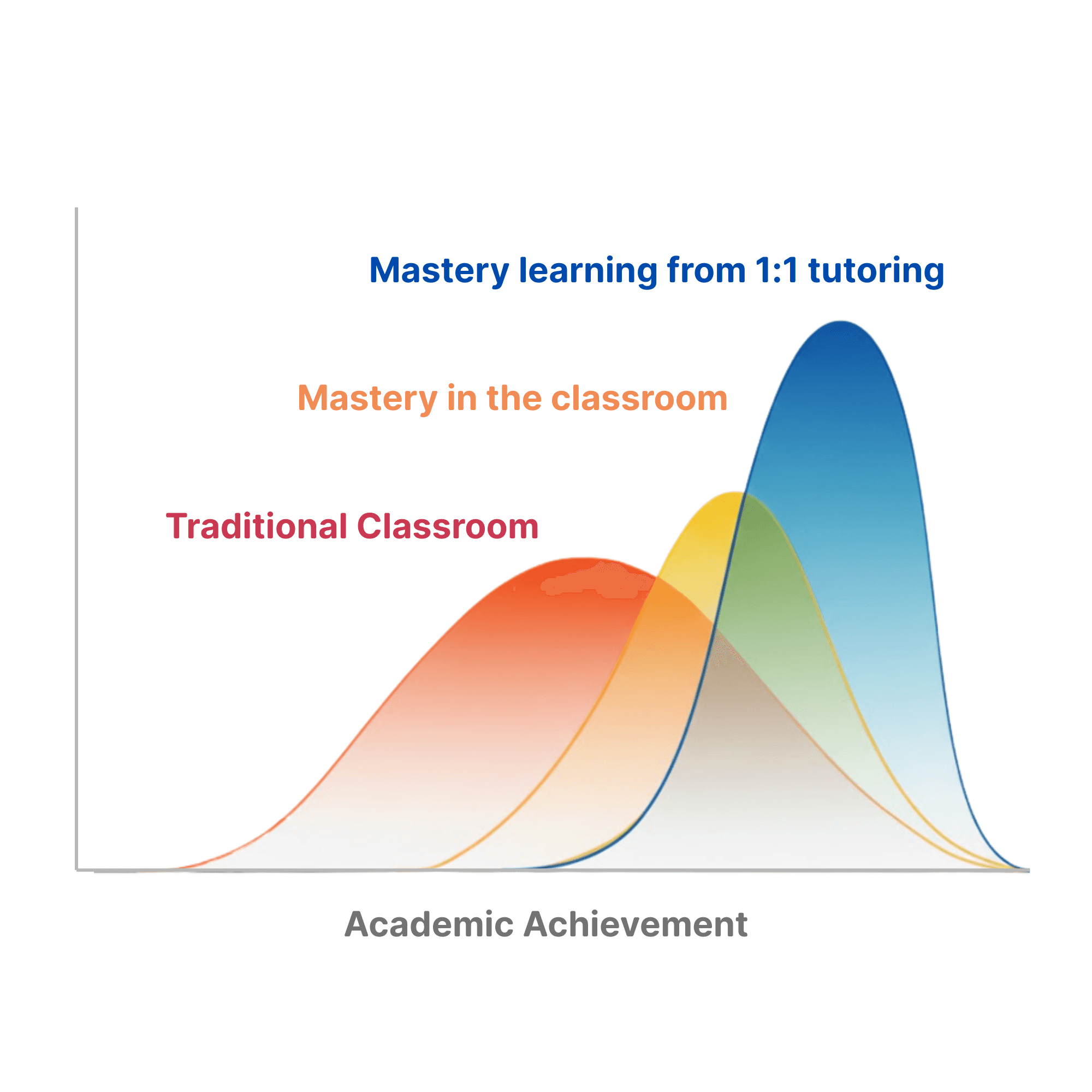
In 1984, the educational psychologist Benjamin Bloom published a finding that should, by rights, have upended the way we think about learning. Students who received one-to-one tutoring combined with mastery learning techniques performed, on average, two standard deviations better than their peers in a conventional classroom. The average tutored student outperformed approximately 98% of those taught in a standard group setting. Not the gifted student. The average one.
Bloom called this the "2 sigma problem" — not because the result was in doubt, but because the challenge it posed seemed almost insurmountable. One-to-one instruction, as he acknowledged, is "too costly for most societies to bear on a large scale."
What Bloom's Research Actually Reveals
The 2 sigma finding is often cited as a straightforward endorsement of private tutoring. In a sense, it is.
But the more careful reading of Bloom's work reveals something subtler, and more demanding: that the quality of the one-to-one interaction matters enormously. Simply placing a student in front of an adult for an hour each week is not, in itself, sufficient. What Bloom's framework emphasises is mastery. The idea that a student should not advance until they have genuinely understood the material in front of them, that gaps should be identified and addressed before they compound, and that the process of correction should be ongoing rather than summative.
This is a meaningfully different philosophy from "exam cramming." It is also, frankly, rarer in practice than one might hope.
The alterable variables Bloom and his students identified — reinforcement, cues and explanations, student participation, time on task, reading and study skills — are not mysteries. They are the basic ingredients of thoughtful teaching. What makes them powerful in a one-to-one context is that a skilled tutor can attend to all of them simultaneously, adjusting in response to a single student rather than managing them across a room of thirty.
Why This Is What Gravitas Does
At Gravitas, we have, in a sense, built our entire model around what Bloom's research implies. Not because we consulted the Educational Researcher before writing our first briefing, but because the principles it describes are, to anyone who has worked seriously in elite education, rather self-evident truths.
Every student we work with receives a thoughtful pairing matched—yes—by subject, but also by temperament, learning style, and the particular nature of their academic challenge. A student who is technically capable but loses confidence under timed pressure requires a very different tutor to one who is enthusiastic but has foundational gaps in algebraic reasoning. The briefing process we run before any first session exists precisely to ensure that the tutor arrives not as a stranger, but as someone who already has a working hypothesis about how to help.
Not only does this approach address the immediate academic challenge — improving marks, sharpening exam technique, preparing for a scholarship paper — but it also, over time, gives students something more durable: a clearer sense of how to think, how to approach difficulty with composure, and how to learn independently. Were a student to carry nothing else from their sessions with a Gravitas tutor, that capacity for self-directed intellectual engagement would, I should think, serve them rather well.
Bloom's challenge to educators was to find ways of replicating, at scale, what the best one-to-one teaching achieves. We are not, at Gravitas, trying to solve that problem in the aggregate. We are, instead, committed to solving it — thoroughly, unhurriedly, and with genuine care — for each student we work with, one at a time.
That is, in the end, the only way it has ever really worked.