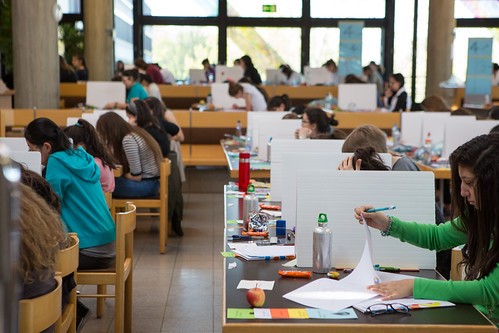
It is now March. For students sitting GCSEs or A-Levels this summer, the revision period has either already begun or is about to. And for many of them, the prevailing instinct will be a familiar one: more hours, more pages, more past papers, no stopping.
The impulse is understandable. The exams feel close and the material feels vast. But there is a growing body of evidence suggesting that this approach is not only unsustainable over a revision period of several weeks, but actively counterproductive. The Pomodoro technique is one of the better-known responses to this problem, and it is worth understanding both why it works and where most students misapply it.
What the Pomodoro Technique Actually Is
The method is straightforward. You study for 25 minutes, then take a 5-minute break. After four of these cycles, you take a longer break of 15 to 30 minutes. The blocks are called "pomodoros" after the tomato-shaped kitchen timer its Italian creator used as a student.
The appeal is structural: by committing to a fixed interval of focused work, you remove the constant low-level negotiation with yourself about whether to continue. The question is no longer "should I keep going?" but simply "has the timer gone off?"
Research from Maastricht University published in Behavioral Sciences (Smits, Wenzel & de Bruin, 2025) found that structured break-taking techniques like Pomodoro were associated with students reporting higher concentration and motivation, and perceiving study tasks as less difficult, compared to students who took breaks entirely on their own terms. Importantly, the research also found that students who had to self-regulate their breaks entirely faced a hidden cost: the mental effort of monitoring themselves and deciding when to stop actually added to cognitive load, leaving less capacity for the work itself.
In other words, the timer does cognitive work that your brain would otherwise have to do.
Cramming has its place; so too does a mindless 5 mins!
For students who feel that taking breaks is a form of weakness or wasted time, the research is worth sitting with. Taking breaks from study tasks allows for recovery of personal resources, motivation and energy, which are necessary for sustaining an effective study session. Attempting to power through without them does not result in more learning; it results in diminishing returns, increased fatigue, and the kind of low-grade anxiety that makes it hard to encode anything properly.
The Maastricht study also explored what they call the "opportunity cost" dimension: studying requires forgoing other things, and that trade-off is easier to make when the student knows a break is coming. Structured breaks reduce the perceived effort of staying in the work, which is why students using them tend to complete more.
For a student with six weeks until their first paper, the arithmetic is straightforward. Eight weeks of sustainable, structured revision will produce better results than three weeks of unsustainable cramming followed by five weeks of exhausted, unfocused revision.
But… the Insight Most Students Miss!
Here is the part that almost nobody mentions when they recommend the Pomodoro technique.
The five-minute break is not for Instagram.
Scrolling through a phone, checking messages, watching a short video — these feel like rest but they are not. They keep the brain in a state of low-level stimulation, which prevents the kind of genuine cognitive recovery that makes the subsequent work session effective. The break needs to be an actual break: a change of state, not a continuation of passive consumption.
But there is a more precise version of this insight, and it is worth taking seriously.
If you have spent 25 minutes doing Maths, the analytical, sequential parts of your brain have been working hard. The break should not engage the same circuitry. Doodle. Sketch something. Make something with your hands. Engage the spatial, creative, non-verbal parts of your brain that were resting during the Maths.
If you have spent 25 minutes reading English or History, processing language and argument, do something that requires a completely different kind of attention. Play a few moves of chess. Pick up an instrument. Go outside and look at something without trying to analyse it.
The principle is cross-domain recovery. You are not trying to stop your brain from working entirely. You are trying to give the specific parts of your brain that have been working a chance to rest, while engaging other parts that have been idle. This is more restorative than simply doing nothing, and significantly more restorative than scrolling.
A student who genuinely understands this will use their Pomodoro breaks differently — and will arrive at each new 25-minute block with more to give.
A Note on Rigidity
One critique of the Pomodoro method worth acknowledging is that the timer can disrupt what researchers call a "flow state" — the condition of deep, absorbed focus in which time disappears and work feels almost effortless. If you have ever been mid-sentence on an essay and had a timer go off, you will recognise the frustration.
The Maastricht research explored a variant called the Flowtime technique, which preserves the structured break duration but allows the student to decide when to take it, based on their own sense of focus. This is worth experimenting with. For students who find the 25-minute intervals disruptive, a slightly more flexible approach, stopping when it feels natural rather than when the timer demands it, may work better.
The underlying principle remains the same: structured, deliberate breaks, used to engage a genuinely different part of the brain, rather than the ambient distraction of a phone.
In Practice
For a student revising for GCSEs or A-Levels over the coming weeks, this translates to something quite simple:
Work in focused blocks of 25 to 45 minutes, depending on what feels sustainable.
When the block ends, stop completely. Do not extend it indefinitely.
Use the break to do something genuinely different from what you were just doing. If it was analytical, do something creative. If it was verbal, do something visual or physical.
After four blocks, take a longer break of at least twenty minutes.
The students who navigate this period well are rarely those who work the most hours. They are the ones who work well, recover properly, and return to each session with their attention intact.
That, as it turns out, requires knowing when to stop.
Source: Smits EJC, Wenzel N, de Bruin A. "Investigating the Effectiveness of Self-Regulated, Pomodoro, and Flowtime Break-Taking Techniques Among Students." Behavioural Sciences, 2025. pmc.ncbi.nlm.nih.gov/articles/PMC12292963